The sundial#
The oldest astronomical instrument is a stick in the ground. A vertical rod – a gnomon, from the Greek for "one who knows" – casts a shadow that tracks the Sun across the sky. At noon, the shadow points due north (in the northern hemisphere). Its length reveals the season: shortest at the summer solstice, longest at the winter solstice. With nothing more than a stick and patience, you can determine the cardinal directions, the time of day, the time of year, and your latitude. Eratosthenes famously used gnomon shadows in two Egyptian cities to calculate Earth's circumference around 240 BCE – and got within 2% of the true value.[1]
Sundials are also why clocks go "clockwise": in the northern hemisphere, a gnomon's shadow sweeps in that direction as the Sun arcs from east to west. The convention outlasted the instrument.
Egyptian obelisks were monumental gnomons. Their shadows swept across marked ground, dividing daylight into segments. The Egyptians and Romans counted twelve "temporal hours" from sunrise to sunset – but these were not equal hours like ours. Each hour was one-twelfth of the daylight period, so summer hours were long and winter hours short.
Temporal hours worked well enough for millennia, but they made astronomy difficult. How do you compare observations across seasons when your unit of time keeps changing? The key innovation came from Islamic astronomers in the 9th–10th century. They discovered that tilting the gnomon to point at the celestial pole – parallel to Earth's axis – makes its shadow rotate at a constant 15° per hour, year-round. Equal hours in all seasons.
The innovation spread to Europe through Spain and the Crusades. By the 14th century, European sundials combined the Islamic polar gnomon with Roman numerals. Equal hours eventually became universal, driven partly by the needs of precise prayer times in Islam and partly by the mechanical clocks that would soon appear.
Measuring duration#
Alongside sundials, people developed devices that measured the passage of time rather than reading it from the heavens. The Egyptian clepsydra – a water clock – measured time by the regulated flow of water through a small orifice. Simple outflow clepsydrae date to at least 1500 BCE. The Chinese built elaborate water-clock towers. Indian and Persian cultures used sinking-bowl clocks, where a pierced vessel gradually filled and sank. Candle clocks, incense clocks, and hourglasses all served the same basic function: counting units of elapsed time.
These devices answer a fundamentally different question from the sundial. The sundial gives a basic astronomical reading. The water clock, an abstract measure of duration.
In practice, though, the leash to the heavens remained short. Water clocks were reset at dawn. Hourglasses were turned at known star-risings. Monks who rang the bells for the canonical hours (fixed times of prayer) calibrated their instruments against sunrise and sunset. Our duration-measuring devices were not accurate enough to fully sever the astronomical connection.
Modeling the cosmos#
The Greeks conceived of the cosmos as a series of nested crystalline spheres, with Earth at the center and the fixed stars on the outermost sphere. The Sun, Moon, and planets each occupied their own sphere, rotating at different rates. The model was wrong about Earth's position, but it was brilliantly useful – it explained the daily rotation of the stars, the monthly motion of the Moon, and the yearly journey of the Sun along the ecliptic.
Armillary spheres#
To make this nested-sphere cosmos tangible, astronomers built armillary spheres: globes of interlocking rings representing the celestial equator, the ecliptic, the tropics, and the polar circles, with a small Earth at the center. The device was invented independently in China (possibly as early as the 4th century BCE) and Greece (3rd century BCE).
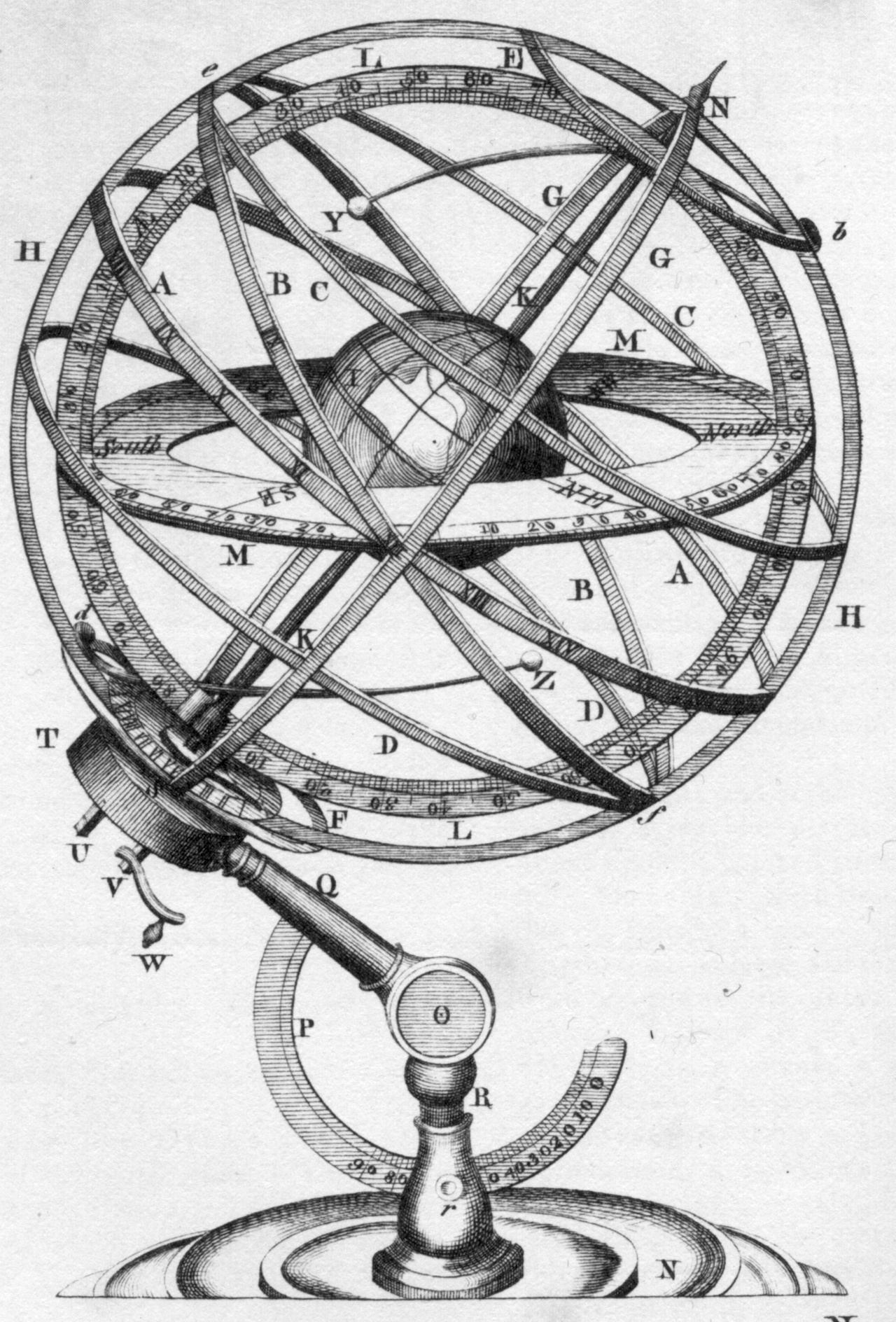
In 125 CE, the Chinese polymath Zhāng Héng (张衡) built the first water-powered armillary sphere – one that rotated automatically to track the heavens.[2] Chinese innovation continued for centuries. Sū Sòng's (苏颂) astronomical clock tower of 1088 CE combined an armillary sphere, a celestial globe, and a time-announcing system, all driven by an escapement – a device that regulates motion through controlled, intermittent release. This predated comparable European clockwork by centuries.
To medieval minds, the armillary sphere was more than astronomy. In Jewish and Christian cosmology, the celestial spheres (Hebrew: galgalim) were thought to be animated by angelic intelligences. Maimonides identified the sphere-movers with angels; Dante placed angelic orders in each planetary sphere. The same word galgalim appears in the ancient Israelite priest Ezekiel's vision of the divine throne – wheels within wheels, covered in eyes – and medieval commentators read this as a description of the celestial spheres themselves. To model those spheres in brass was, in a sense, to model angelic reality.
The Antikythera mechanism#
In 1901, sponge divers discovered a Roman-era shipwreck off the Greek island of Antikythera. Among the artifacts was a corroded bronze mass that would take decades to decipher. Modern imaging eventually revealed an intricate clockwork mechanism dating to around 100 BCE – over a thousand years before anything of comparable complexity would appear anywhere in the world.[3]
The Antikythera mechanism was a mechanical computer. Its interlocking gears tracked the positions of the Sun and Moon, predicted eclipses using the Saros cycle (explained on the astronomy page), indicated the lunar phase, and may have shown planetary positions. It even tracked the four-year cycle of the Olympic Games.
We don't know who built it, or how widespread such devices were. It stands as evidence that ancient astronomical sophistication far exceeded what we once assumed. There is a gulf of more than eight centuries between the Antikythera mechanism and the next comparably advanced mechanical device – Yī Xíng's water-powered astronomical clock in 8th-century China. European geared clockwork would not appear for another five hundred years after that.
The astrolabe#
Around 200 BCE, Greek mathematicians discovered that stereographic projection could flatten the celestial sphere onto a plane while preserving a crucial property: circles on the sphere project as circles (or straight lines) on the plane. This meant that the celestial equator, the ecliptic, the horizon for any latitude – all the great circles an astronomer cares about – could be engraved as precise circular arcs on a flat metal disc. Two such discs, one representing the local sky and one the stars, could then be stacked and rotated against each other to simulate the turning of the heavens. The result was the astrolabe – the entire visible sky compressed into a brass disc you can hold in one hand.
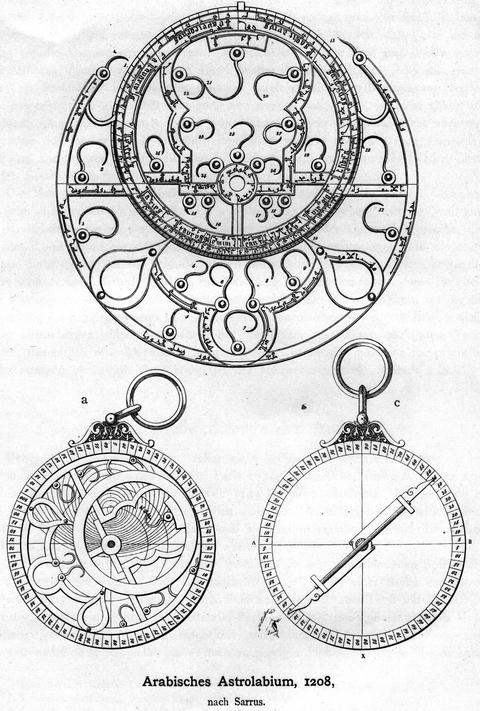
A disc with a wide, raised rim – the "mater" (mother) – holds one or more removable plates called "tympans," each made for a specific latitude and engraved with azimuth and altitude circles representing the local sky above the horizon. Over the tympan sits the "rete," an intricate openwork framework bearing the ecliptic and pointers marking the brightest stars. The rete represents the heavens: rotate it, and the stars and ecliptic move over the coordinate lines on the tympan below, one full turn for each day. On the back, a sighting bar called the alidade lets you measure the altitude of the Sun or a star. Read the altitude, set the rete accordingly, and you could determine the time, your latitude, or predict when any star would rise or set.
Greek and Hellenistic astronomers developed the principles, but it was during the Islamic Golden Age, from the 8th century onward, that the astrolabe reached its full sophistication. Islamic craftsmen elevated astrolabe-making to high art, producing instruments of extraordinary beauty and precision. For Muslim astronomers and the faithful, the astrolabe also solved critical practical problems: determining the direction of Mecca from any location and calculating the times for the five daily prayers. It was both scientific instrument and religious tool.
Through Islamic Spain and the Crusades, the astrolabe passed to medieval Europe, where it became essential for astronomers, navigators, and astrologers alike. Geoffrey Chaucer wrote a treatise on the astrolabe for his son in 1391 – one of the oldest technical manuals in English.
The rete is a map of the stars, their positions fixed in brass. To use the astrolabe is to engage directly with the cosmos above. The Spacetime Watch alludes to this tradition – a portable illustration of the sky's current state, carried on your wrist.
The abstraction of time#
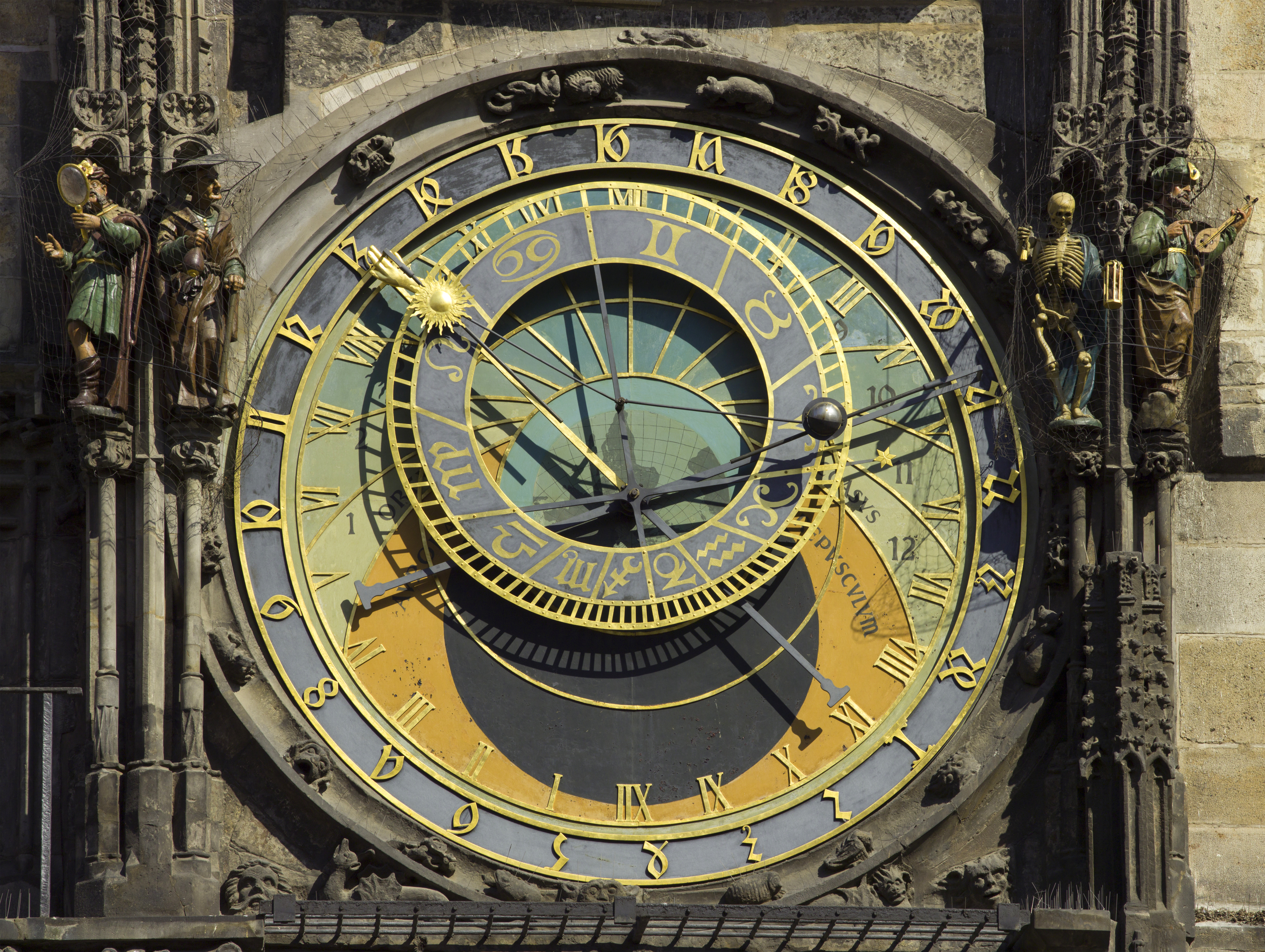
The finest astronomical clocks tried to have it both ways – mechanical precision and cosmic awareness. The Prague Orloj, installed in 1410 and still running today, is essentially a giant mechanical astrolabe. Its main dial shows the Sun and Moon moving against the zodiac ring, with horizon lines marking sunrise and sunset for Prague's latitude – exactly like a traditional astrolabe, but driven by gears instead of human hands. But simpler mechanical clocks – without astronomical displays – were spreading faster.
Mechanical clocks#
Sometime in the late 13th century, European craftsmen built the first clocks driven by a falling weight regulated by a verge-and-foliot escapement. The early tower clocks were installed in monasteries and cathedrals, where the regulation of communal prayer had always driven the demand for timekeeping. They often had only an hour hand. But unlike the water clocks that came before, they could run continuously for days. They still needed regular calibration against sundials, but the leash to the sky was growing longer.
Christiaan Huygens introduced the pendulum clock in 1656, dramatically improving accuracy. His balance spring of 1675 made accurate portable timekeeping possible – the direct ancestor of every mechanical watch. The clock face abstracted time completely. Time became a number rather than a state of the sky.
Standardization and severance#
Until the 19th century, each town kept its own local solar time. Noon was when the Sun reached its highest point. Bristol ran ten minutes behind London; Paris ran ten minutes ahead. Railways shattered this. Trains needed synchronized schedules across distances, and the chaos of local times made timetables impossible. By the 1880s, most of the world had adopted standardized time zones, each one hour apart. Clock time became completely divorced from the Sun's actual position. Today, "noon" can mean the Sun is half an hour or more from its highest point – and over an hour off during daylight saving time.
Then came the artificial light. Thomas Edison demonstrated his practical incandescent bulb in 1879. Within decades, cities glowed through the night. Light pollution drowned out the stars. For more than a third of humanity, the Milky Way is completely invisible.[4]
The final severance came in 1967, when the second was redefined. No longer was it 1/86,400 of a solar day. It became exactly 9,192,631,770 oscillations of a cesium-133 atom. Time was now measured by quantum mechanics, not the turning of the Earth. For the first time in human history, time had no definitional connection to the sky.
Astronomical complications#
Even as ordinary clocks pulled time away from the heavens, some watchmakers refused to let go. Abraham-Louis Breguet (1747–1823), perhaps the greatest watchmaker who ever lived, spent decades perfecting astronomical complications – mechanisms that kept celestial awareness alive in pocket-sized form. His watches could show moon phases and perpetual calendars. His masterpiece, the "Marie Antoinette" watch, took 44 years to complete[5] and incorporated every known complication of its era.
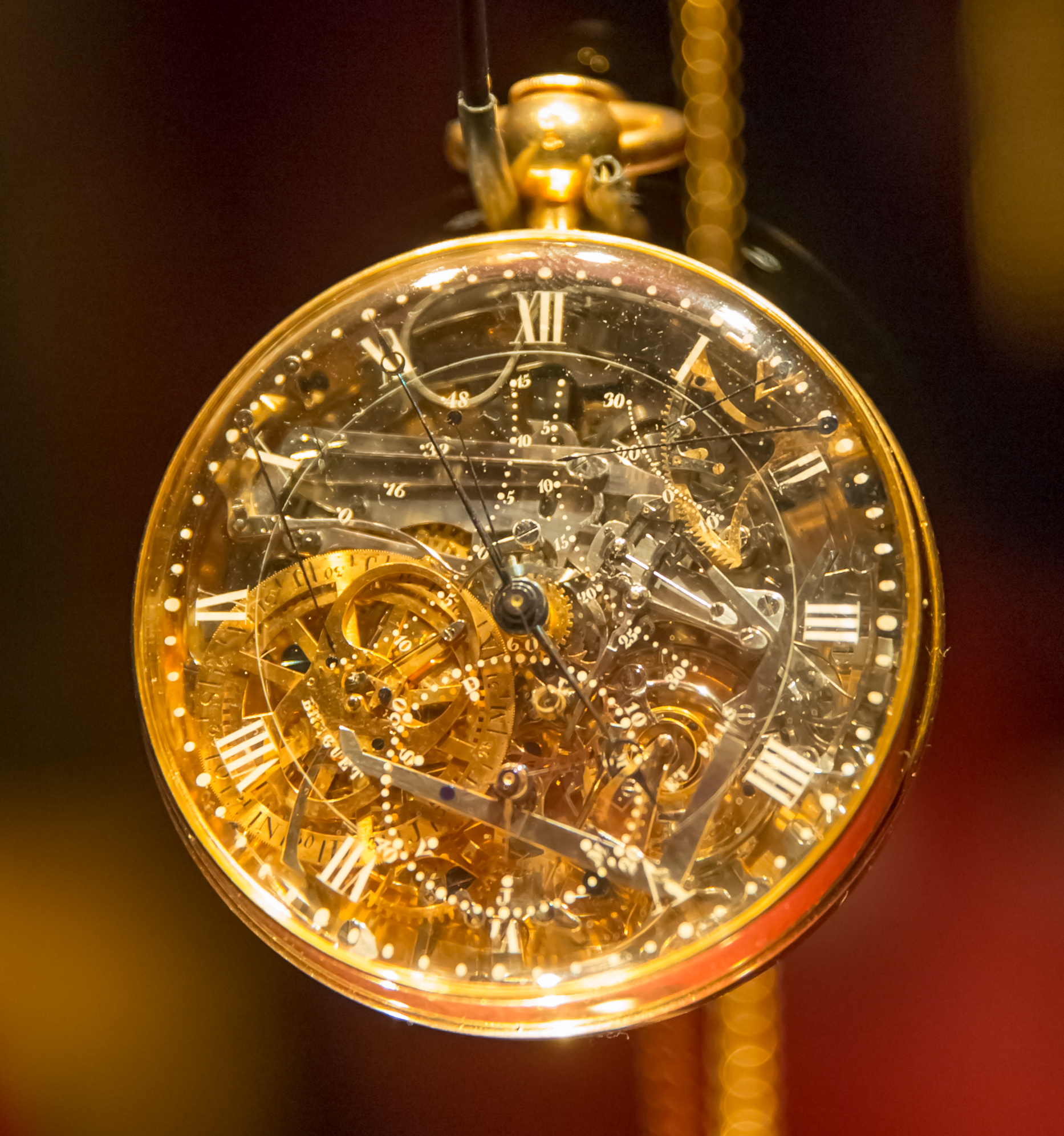
Photo: Michael.vainshtein, CC BY-SA 4.0
This tradition reached its apex in 1933 with the Patek Philippe "Graves Supercomplication," commissioned by banker Henry Graves Jr. With 920 hand-crafted components and eight years of work, it remained the most complicated watch ever made without computer assistance for over 50 years. Among its 24 complications was a celestial chart showing the night sky exactly as it appeared from Graves's Fifth Avenue apartment in New York – an astrolabe for the 20th century, its stars turning in real time overhead.
But at $24 million (the Supercomplication's 2014 auction price)[6], such marvels remained the province of the ultra-wealthy. The cosmos stayed out of reach for ordinary people.
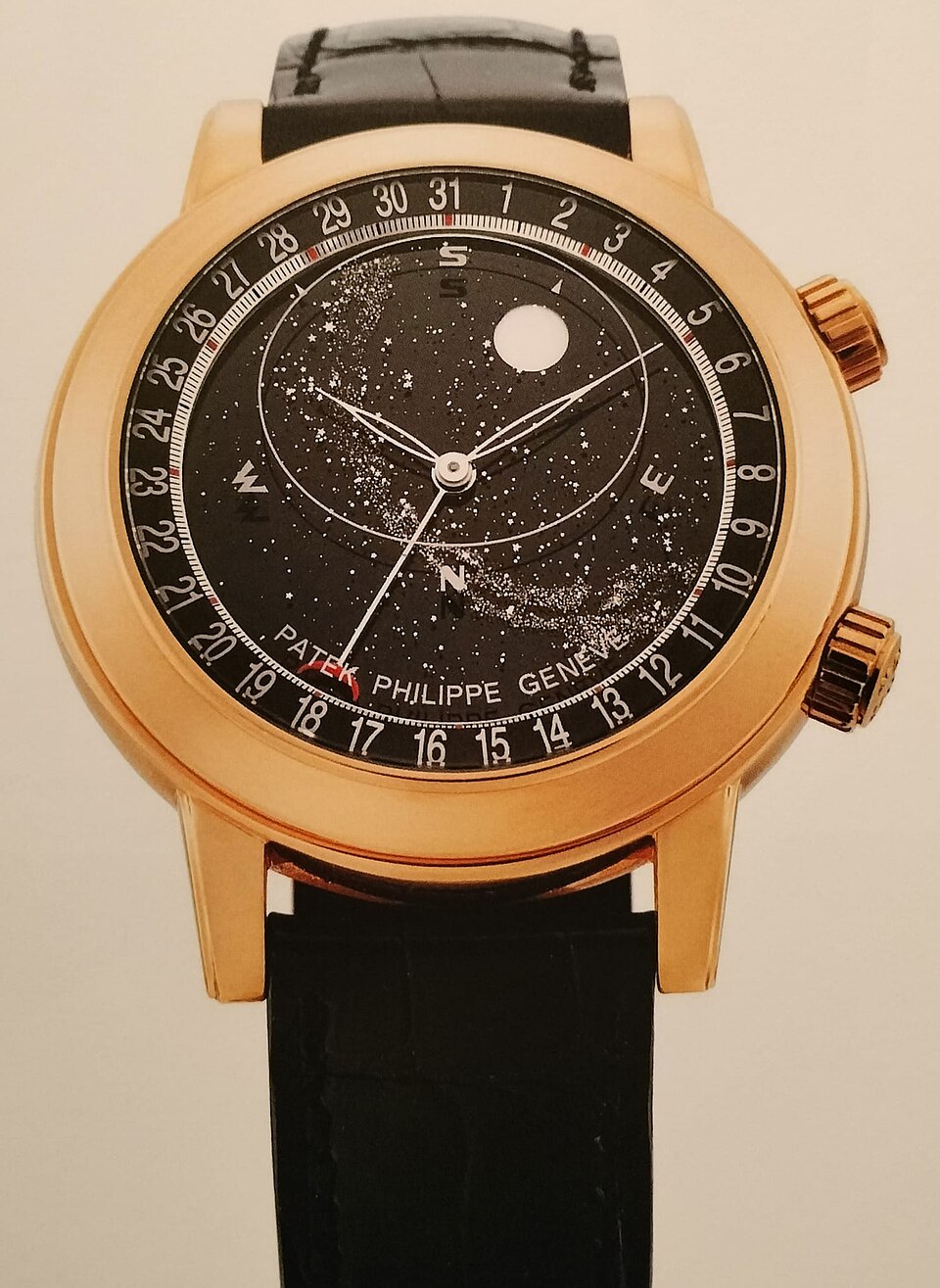
No freely licensed images of the Graves Supercomplication exist, but a contemporary descendant illustrates the tradition well: the Patek Philippe Celestial ref. 6102. With its own rotating star chart and moon phase display, it is perhaps the closest thing in traditional watchmaking to what the Spacetime Watch does digitally. It costs "only" about $450,000.[7]
Full circle#
This history has two threads. One is the reading of the sky – gnomon shadows, astrolabes, the Prague Orloj – where time is understood as the state of the heavens. The other is the measuring of duration – water clocks, escapements, cesium atoms – where time is an abstract quantity, counted out by a mechanism. For most of history the two were intertwined: every duration-measuring device needed the sky to stay calibrated. Mechanical clocks slowly loosened that dependency, and atomic clocks severed it entirely. We gained extraordinary precision, but lost the sky.
Early modern technology pulled us away from the sky, but has now advanced far enough to reconnect us. What once required 920 hand-crafted components, eight years of labor, and a banker's fortune can now be calculated in milliseconds and run on anyone's wrist, on a smartwatch.
The Spacetime Watch is an attempt to show time as a state of the sky, as a constant invitation to look up from your wrist and marvel at the real thing. We live on a spinning ball that is gliding through space at 100,000 km/h, together with our lunar companion, with a view to our planetary peers, half the time blinded by the life-giving Sun we are all orbiting. It's incredible, and it's actually happening right now, and it's far too easy to forget.
References#
- Carman, C.C. & Evans, J. (2015). The Two Earths of Eratosthenes. Isis, 106(1), 1-16.
- Needham, J. (1959). Science and Civilisation in China, Vol. 3: Mathematics and the Sciences of the Heavens and the Earth. Cambridge University Press.
- Freeth, T., Bitsakis, Y., Moussas, X., Seiradakis, J.H., Tselikas, A., Mangou, H., Zafeiropoulou, M., Hadland, R., Bate, D., Ramsey, A., Allen, M., Crawley, A., Hockley, P., Malzbender, T., Gelb, D., Ambrisco, W. & Edmunds, M.G. (2006). Decoding the ancient Greek astronomical calculator known as the Antikythera Mechanism. Nature, 444, 587-591.
- Falchi, F., Cinzano, P., Duriscoe, D., Kyba, C.C.M., Elvidge, C.D., Baugh, K., Portnov, B.A., Rybnikova, N. & Furgoni, R. (2016). The new world atlas of artificial night sky brightness. Science Advances, 2(6), e1600377.
- Breguet, E., Aked, C.K. et al. (2015). Breguet: Art and Innovation in Watchmaking. Fine Arts Museums of San Francisco / Legion of Honor exhibition catalog.
- Sotheby's (2014). Henry Graves Supercomplication by Patek Philippe. Important Watches auction, Geneva.
- Patek Philippe (2026). Grand Complications, Ref. 6102P-001. Patek Philippe official collection.