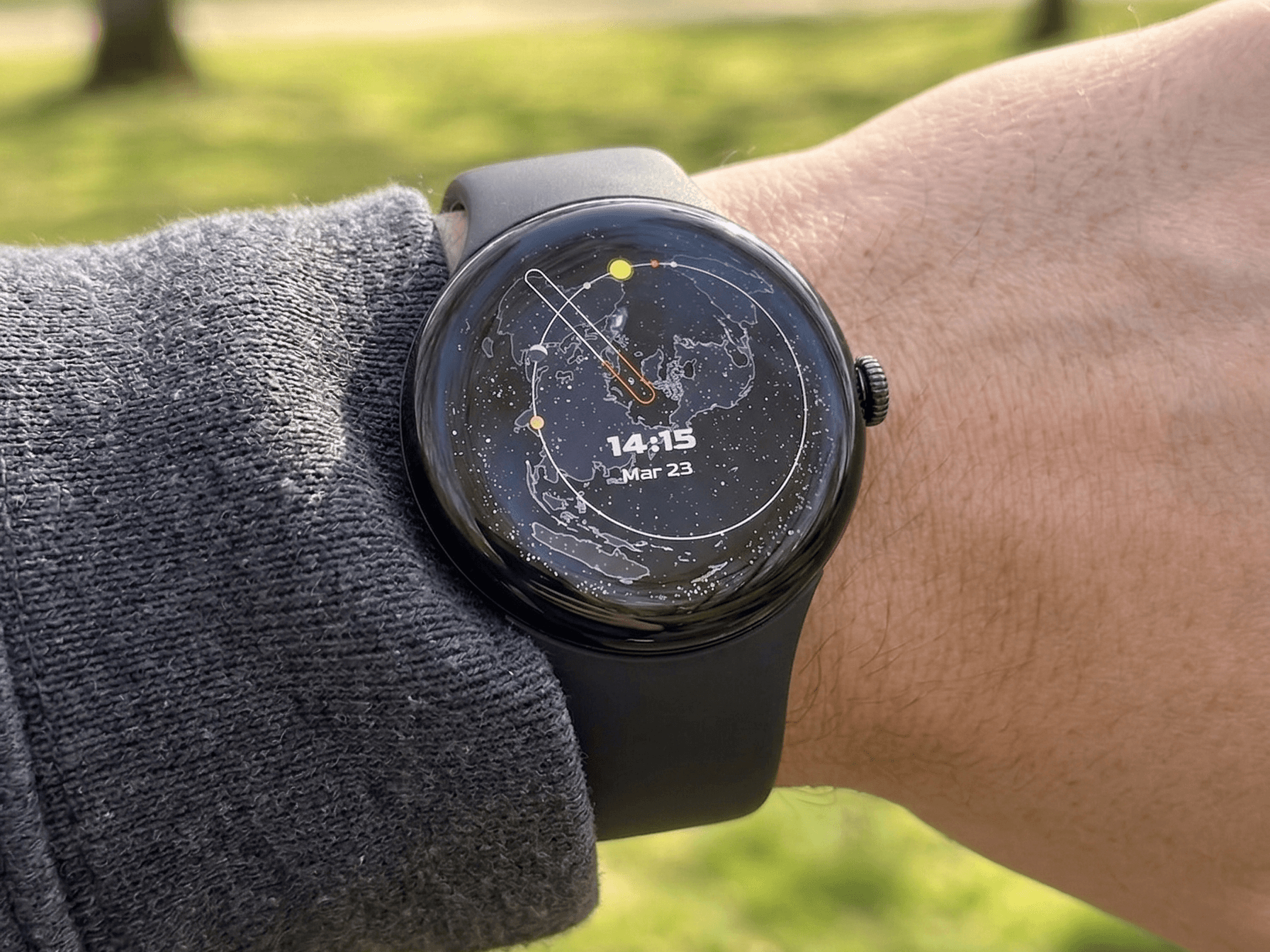
Full explanation
How to read the Spacetime Watch and understand the astronomy behind timekeeping
Counterclockwise revolution#
The Earth rotates on its axis once per day, so if we put a rotating North Pole-centered map on a 24 hour clock, we can see what time it is everywhere on Earth at once.
The Earth rotates counterclockwise when seen from the North Pole, so our clock will have to do the same. It is unfortunate to have to go against the universal convention that clocks go clockwise, but the only reason we have this convention is that people used sundials to tell the time, and the shadow moves clockwise across the dial. The rotational direction of the Earth itself is much more suitable for a modern clock. It is time for a counterclockwise revolution.
In the visualization above, the blue line works as an hour hand for the specified time zone, simply by highlighting the central longitude of that time zone.
The direction of the hour hand also serves as a "compass needle" pointing south. This means that with the full Spacetime Watch, you will be able to find the cardinal directions by aligning the watch face with any celestial objects you can identify in the sky. More on that later.
The compass direction will only be a rough estimate, because your actual longitude probably differs a bit from your time zone's central longitude. This inaccuracy gets considerably worse during daylight saving time, when time zones are shifted one step counterclockwise, for long obsolete historical reasons.
Map projection#
The watch uses a North Pole-centered azimuthal equal-area projection, which flattens the Earth into a circle while preserving relative areas. This works fairly well because most of Earth's land mass is in the northern hemisphere. The projection's biggest weakness is that whatever is at the South Pole becomes a thin smudge covering the entire circumference. Luckily, Antarctica can be ignored, at least for watch face purposes, and on the Spacetime Watch, it has been entirely removed, for aesthetic reasons.
Below, you can see an animated transformation between two projections:
- Orthographic: Earth as seen from the Sun's perspective at our vernal equinox.
- Azimuthal: The flat equal-area projection used on the watch face.
The arrow indicates Earth's counterclockwise rotation.
The sky map#
The night sky can be mapped onto the same projection. Stars, galaxies, and the Milky Way all have fixed positions on the celestial sphere. Click the buttons to show some highlights.
East and west are flipped for the sky map, because we project it as if viewing the celestial sphere from outside, so that it aligns with the Earth map underneath. That's why the constellations look mirrored.
Sagittarius A* is the supermassive black hole at the center of our Milky Way galaxy, about 26,000 light-years away. While invisible itself, it's surrounded by glowing matter and represents the rotational center of our galaxy. It is marked by a black dot in the middle of the big smudge that represents the central side of the Milky Way.
Andromeda is our nearest major galactic neighbor – a spiral galaxy about 2.5 million light-years away. It's the most distant object visible to the naked eye and is slowly approaching us at 110 km/s. In about 4.5 billion years, Andromeda and the Milky Way may collide and merge (we're not 100% sure, see the astronomy page for more info).
The Sun, Moon and planets#
As viewed from Earth, the Sun, Moon, and planets move relative to the background of fixed stars. To understand their motion, we need to understand the plane they travel on, which is roughly the same for most orbits in our Solar System. The exact reference we'll use is the yearly path the Sun traces against the background of the stars, which is called the ecliptic. The Moon and planets have orbits that are a few degrees off from the ecliptic plane, but we simplify this on the Spacetime Watch, for aesthetic reasons, by snapping them to the ecliptic.
Earth's axis is tilted 23.5° from perpendicular to this plane. This tilt stays fixed in space as Earth orbits, causing the seasons, as the hemispheres get more or less sunlight if pointed toward or away from the Sun.
Winter in the Northern Hemisphere, summer in the Southern. The North Pole tilts away from the Sun – shortest day in the north.
If the ecliptic path were visible in the sky, it would look like a line fixed against the stars. All the objects of the Solar System appear to move roughly along this path, as they and we travel around the Sun on our orbits.
This is not to be confused with the path each celestial object takes across the sky over the course of the day (or night), which is determined by the Earth's axial rotation, not orbits. The image above shows exactly noon, and so the Sun is at the highest point in the sky it will be on that day. The date is set to the vernal equinox, so the ecliptic line looks quite tilted from our noon point of view.
There's an interactive demonstration of how this all works on the astronomy page.
Putting the ecliptic line on our map projection, it becomes a circle again (actually slightly elliptical because of the equal-area azimuthal projection). This allows us to see the positions of all the celestial objects of our Solar System, whether they are above or below our horizon. The side of the ecliptic that is closer to the center will be higher in the sky in the northern hemisphere and lower in the southern hemisphere. In technical terms, radial distance relates to declination.
Even though they are snapped to the ecliptic, the angular positions of the Moon and planets are accurate (in terms of what astronomers call "right ascension"). This means that if you turn toward the Sun, and see on your watch face that the Moon is, let's say, 90 degrees to its left, you can turn roughly 90 degrees left and expect to see the Moon – if it is above the horizon. This works for all the planets and constellations as well. If you can identify one celestial object, the Spacetime Watch can help you find anything else.
Celestial motion#
Since we have defined the top of the clock circle to be noon, and the Sun appears to make one full rotation around the ecliptic circle as the Earth travels along on its orbit, we need to give the whole star map one clockwise rotation per year to make sure the Sun stays roughly at the noon position.
The Spacetime Watch then has two rotating layers: The Earth map making one counterclockwise rotation per day, and the sky map making one clockwise rotation per year. Here's a similar animation to the one near the top of the page, this time with the additional speed setting of 1 year/sec, where we show what it looks like if we keep the star map fixed.
At 1 day/sec, you see the Moon traveling around the ecliptic, changing its phase accordingly. You also begin to see the sky map slowly rotate.
At 1 week/sec, we hide the Earth map, as it becomes a dizzying swirl. The Moon now races around the ecliptic, roughly once every four seconds. We also clearly see the Sun moving against the stars, and the inner planets, Mercury and Venus, swinging back and forth near the Sun. Since all planets orbit counterclockwise around the Sun, and planets closer to the Sun move faster, we see Mercury and Venus going behind the Sun when moving from right to left, and in front when moving from left to right.
At 1 month/sec, you might notice the "retrograde motion" of planets around opposition (that is, when they are furthest from the Sun on the ecliptic). This is particularly noticeable with Mars, which clearly moves counterclockwise relative to the stars for most of the year, but then turns around and moves clockwise relative to the stars for a few months when it is near the bottom of the clock. This happens as Earth, on its faster inner orbit, overtakes the outer planets.
At 1 year/sec, retrograde motion becomes very obvious. You can also see the rings of Saturn slowly opening and closing, as our viewing angle on its 26.7° tilted axis changes over the course of the Saturnian year. In 2025, we saw it edge-on, so the rings were almost invisible. In 2032, it will be the Saturnian summer solstice, meaning that its axis will point toward the Sun, making the rings much more visible from Earth.
The complete watch#
The final watch face adds the hour hand and text display to create a complete astronomical timepiece – here's a fullscreen display. As mentioned at the start, the hour hand represents the longitude of your time zone and doubles as a rough compass needle: align the watch face with the sky, and the red side of the hand points north, the white side south.
How do you align it? If you see the Sun or Moon or any other celestial object in the sky, find it on the watch face. Turn your body until its position on the watch matches where you see it in the sky. Now the compass needle hour hand will be pointing roughly south, and all celestial objects will be roughly in the directions suggested by the watch face.
The colored segments of the hour hand meet at a configurable point, meant to be set to your approximate latitude. On the Wear OS watch face, you can find this in the settings under "Hand Color Split". Here on the website, it is automatically set by the latitude of the city in your browser's time zone (e.g. 'Europe/Oslo').
Half of the sky is above the horizon at any one time. Which half depends on your latitude, but as a rough guide, objects on the right side of the watch face are in the morning sky, the top during the day, the left in the evening, and the bottom at night.
Below, the dashed line shows the exact shape of the horizon for the selected latitude. Drag the slider to see how it warps due to the projection. Due to Watch Face Format (WFF) constraints, this visualization is not available on the watch face itself.
In-depth articles#
- Astronomy: See constellations melt as stars drift over hundreds of thousands of years. Learn why photographing the Sun at the same time each day traces a figure-8 in the sky, why eclipses repeat in an 18-year cycle, and how Polaris will lose its place as the North Star over millennia as the Earth's axis slowly wobbles.
- History: From sundials and water clocks to armillary spheres and the astrolabe to mechanical clocks – how timekeeping first taught us astronomy, then severed its connection with the sky, and how smartwatches allow us to reconnect.