Cosmic time scales#
Axial precession#
Earth's axis wobbles like a spinning top. The North Celestial Pole traces a circle around the North Ecliptic Pole, completing one full circuit every 26,000 years. The cause is tidal forces from the Sun and Moon tugging on Earth's equatorial bulge. Because Earth is spinning, this torque causes the axis to wobble rather than straighten.
The visualization below, running at 5000 years/sec, shows what this looks like in the same projection as the watch face (see the illustrated explanation on the front page). The blue dot at the center is the North Celestial Pole at the specified time – where we today find Polaris. The red dot is the North Ecliptic Pole, the fixed point around which precession occurs. Press play and watch the trail trace the axial pole's path.
It's not quite a circle: Earth's axial tilt also oscillates between 22.1° and 24.5° over a separate 41,000-year cycle called obliquity variation. Because the precession cycle (26,000 years) and obliquity cycle (41,000 years) don't align, the path forms a spirograph pattern rather than a perfect circle.
The precession appears clockwise in the visualization because our star map projection views the celestial sphere from outside, flipping east and west. Looking up at the actual sky, the precession traces its path counterclockwise around the ecliptic pole – the same direction as Earth's rotation, its orbit, and nearly every other orbit in the solar system (the biggest exception being Neptune's moon Triton, a captured Kuiper Belt object that orbits retrograde).
Precession means the role of the North Star is temporary. When the Egyptian pyramids were built around 2500 BCE, Thuban in Draco was the pole star. In 12,000 years, brilliant Vega will take the role.
Hipparchus discovered precession around 130 BCE by comparing his own star observations against records from a few hundred years earlier. He noticed that the positions of stars relative to the equinox points had shifted uniformly – proof that the equinoxes themselves were drifting along the ecliptic. He estimated the rate at about 1° per century, roughly two-thirds of the actual value.
Stellar proper motion#
In 1718, Edmond Halley (of comet fame) was studying ancient star catalogs when he noticed something troubling. Three of the brightest stars in the sky – Arcturus, Sirius, and Aldebaran – had shifted position since Hipparchus recorded them nearly two thousand years earlier. The "fixed stars" were not fixed at all.
What Halley had discovered was proper motion: stars drifting across our sky over centuries. This apparent movement reflects real motion – stars falling toward or away from us, drifting sideways at tens or hundreds of kilometers per second. Over human lifetimes, these motions are imperceptible. Over millennia, they reshape the constellations.
The visualization below shows 200,000 years of stellar motion – enough time for the familiar constellations to dissolve completely. The Big Dipper distorts beyond recognition. Stars brighten as they approach and fade as they recede. New patterns emerge that no human will ever name. The night sky of our distant descendants will bear little resemblance to ours.
How fast a star appears to move depends largely on its distance. Nearby stars can shift noticeably over centuries, while distant stars barely seem to move at all – their great distances make even enormous velocities appear frozen. Our Sun is not stationary either. We are moving relative to our stellar neighborhood toward the constellation Hercules at about 20 kilometers per second. Astronomers call this direction the "solar apex." The stars we call neighbors today will be strangers in a few million years; our stellar neighborhood is constantly reshuffling.
The galactic year#
Our Sun is one of an estimated 200-400 billion stars in the Milky Way, all orbiting Sagittarius A*, the supermassive black hole at the center of our galaxy. At our orbital radius of about 26,000 light-years, the Sun takes approximately 225–250 million years to complete one orbit – a period astronomers call a galactic year.
The numbers are staggering. We're moving at about 230 kilometers per second – fast enough to circle Earth's equator in under three minutes. Yet the galaxy is so vast that even at this speed, we crawl around our orbit. Since the Sun formed 4.6 billion years ago, it has completed only about 20 galactic orbits. The Milky Way itself is roughly 13.6 billion years old – about 60 galactic years.

NASA/JPL-Caltech artist's impression of the Milky Way
To put this timescale in perspective: the last time the Solar System was at roughly this position in its galactic orbit, it was the early Triassic period. The great Permian extinction had just ended, and the first dinosaurs were only beginning to appear. By the time they died out, they hadn't made a single round trip. The time of their extinction is marked on the visualization.
This orbital motion has consequences we can measure. As the Sun moves through the galaxy, it periodically passes through regions of higher stellar density, through spiral arms with active star formation, and oscillates above and below the galactic plane, crossing it about every 30 million years. Some researchers have proposed that this vertical bobbing might correlate with mass extinction events – perhaps through increased comet impacts from gravitational perturbations, or enhanced cosmic ray exposure near the galactic plane. The evidence remains debated, but the hypothesis illustrates how our galactic environment might shape the history of life on Earth.
Rendezvous with Andromeda#
For centuries, the Andromeda "nebula" was thought to be a cloud of gas within our own galaxy. That changed in 1923, when Edwin Hubble identified Cepheid variable stars within it – stellar distance markers that proved Andromeda was not a nebula at all, but an entirely separate galaxy 2.5 million light-years away. The universe was soon understood to be vastly larger than anyone had previously imagined.
Hubble's discovery came with an unsettling detail: Andromeda's light was blueshifted. Unlike nearly every other galaxy in the universe, which redshift as they recede from us, Andromeda is approaching. Precise measurements from the Hubble Space Telescope show it falling toward the Milky Way at about 110 kilometers per second, drawn by our mutual gravitational attraction.[1]
For years, astronomers believed a collision was inevitable. But a 2025 study incorporating the latest data from Hubble and the Gaia spacecraft revealed a surprise: there is only about a 50% chance the galaxies will ever merge.[2] The key factor is the Large Magellanic Cloud (LMC), a smaller galaxy currently falling into the Milky Way. Though the LMC has only about 15% of our galaxy's mass, its gravitational pull – directed at an angle to the Milky Way–Andromeda trajectory – is enough to nudge us off course. (Triangulum, by contrast, increases the merger probability – the two effects partially cancel.) In many simulations, the galaxies swing past each other without merging.
If a Milky Way–Andromeda collision does occur, it would unfold over billions of years. "Collision" is misleading – galaxies are mostly empty space. The distance between stars is so vast that individual stellar collisions would be extraordinarily rare. Instead, the galaxies would pass through each other, their mutual gravity stretching both into long tidal streamers. They might swing apart and fall back together, eventually merging into a single elliptical galaxy astronomers have nicknamed "Milkomeda."
But even without a merger, Andromeda will put on quite a show. It currently appears as a faint smudge about 3° across (six Moon widths), barely visible to the naked eye. Over the next few billion years, it will grow steadily larger in the sky as the galaxies approach – a great spiral of hundreds of billions of stars becoming ever more prominent overhead.
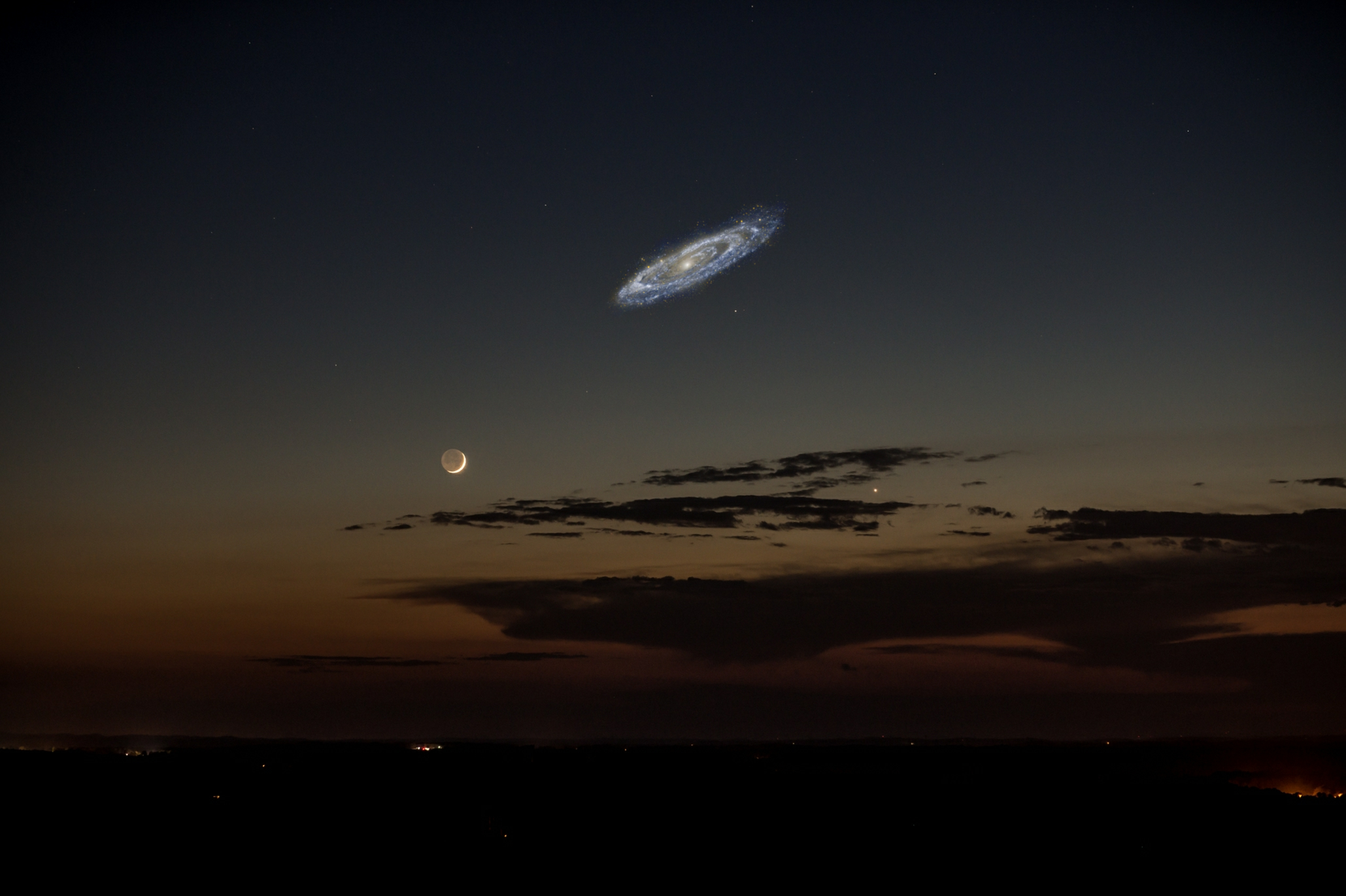
The Milky Way has already absorbed several smaller galaxies in its history; you can see the remnants of one, the Sagittarius Dwarf Elliptical Galaxy, being stretched into a stream of stars that wraps around our galaxy even now.
Whether Andromeda becomes our next major merger or merely a close encounter this time around, the Local Group – our gravitational neighborhood of the Milky Way, Andromeda, Triangulum and many dozens of dwarf galaxies – will eventually merge into a single giant elliptical galaxy. And that merged galaxy will be alone. The accelerating expansion of the universe is gradually pulling everything else away from us, and eventually they will be receding faster than light can travel. In about 100 billion years, every galaxy beyond the Local Group will have crossed the cosmic event horizon – the distance beyond which nothing we send could ever reach them, and no new light from them could ever reach us. For a long time, we would still see their ancient light – ghosts of where they were billions of years ago – but within about a trillion years, even that will have redshifted into invisibility. Our distant descendants, if any exist, will inhabit a universe containing only one galaxy, with no evidence that anything else ever existed.
Earth's formation#
About 4.5 billion years ago, shortly after the Solar System formed, a Mars-sized body called Theia slammed into the young Earth, vaporizing both impactor and much of Earth's crust. The debris coalesced into the Moon, initially orbiting just beyond the Roche limit – roughly 3 Earth radii, or about 20,000 kilometers – barely far enough to avoid being torn apart by tidal forces.
At that proximity, the Moon would have dominated the sky, appearing 20 times larger than it does today. But this unseen visual spectacle was the least of it. Tidal force scales with the inverse cube of distance: at one-twentieth the current separation of about 60 Earth radii, tidal forces were roughly 8,000 times stronger than today. The consequences were dramatic. The early Earth experienced what could be called gravitational kneading. The tidal deformation was perhaps 3 km for solid rock, or over 10 km for the magma ocean that covered the planet after Theia's impact.
As an aside: the Moon still flexes solid rock today, a phenomenon called Earth tide. The ground beneath your feet rises and falls by about 20 centimeters twice daily as the tidal bulge passes. You don't notice because everything around you rises together, and it happens so slowly and smoothly that it causes no earthquakes. But it's real enough that CERN must account for it – the circumference of their particle accelerator changes measurably with the tides.
The Himalaya-sized tidal waves of molten rock on the early Earth moved fast, too. Earth spun once every 5 hours (the giant impact imparted enormous angular momentum), while the Moon orbited in the same plane and direction in about 8 hours. The tidal bulge is locked to the Moon's position, so from any point on the fast-spinning Earth, it passed overhead roughly every 7 hours – the beat period between the two rates. This constant flexing generated enormous heat through friction, keeping the planet molten far longer than it otherwise would have been.[3]
After roughly 100,000 years, the magma ocean finally solidified, though the Moon had receded only to about 7–9 Earth radii[4] – still close enough to loom seven times larger than today and exert tides hundreds of times stronger than we now experience.
This prolonged molten state was formational. It allowed Earth to fully differentiate: heavy iron and nickel sinking to form the core, lighter silicates rising to form the mantle and crust. This differentiation created the conditions for Earth's magnetic field. The field isn't generated by the core spinning at a different rate than the mantle – it's driven by convection. Heat from the inner core drives churning currents in the liquid outer core; because this electrically conductive fluid is both moving and rotating with the planet, it generates electric currents that produce magnetic fields. The faster rotation of the early Earth may have actually strengthened this dynamo effect. The resulting magnetic shield protects our atmosphere from being stripped away by the solar wind. Without differentiation, no dynamo → no magnetic shield → no atmosphere → no life.
The intense tidal heating also drove extraordinary volcanism. Volcanoes are how planets exhale – releasing gases trapped in rock. Water vapor, carbon dioxide, nitrogen, and sulfur compounds poured from countless eruptions, building up the early atmosphere. When Earth finally cooled enough for water vapor to condense, these volcanic exhalations became the oceans. The carbon that life would later build itself from was pumped to the surface through this geological hyperventilation.
Some researchers believe the intense early tidal stresses also helped initiate plate tectonics – the slow churning of Earth's crust that recycles carbon, builds mountains, and maintains the chemical cycles life depends on. Whether or not tides were the trigger, the early Moon certainly influenced how the crust fractured and evolved.
Our tidal interaction is also the reason the Moon is slowly receding. Because Earth rotates faster than the Moon orbits, the tidal bulge is dragged slightly ahead of the Moon's position. This leading bulge pulls the Moon forward, accelerating it, making it rise to a higher orbit. Meanwhile, the Moon pulls back on the bulge, slowing Earth's rotation. Angular momentum flows from Earth's spin to the Moon's orbit: we slow down, it moves away. Over 4.5 billion years, the Earth-Moon system has dissipated roughly 99% of its initial mechanical energy as tidal heat.[3] Laser ranging to reflectors left by Apollo astronauts measures this recession precisely: it is currently 3.8 centimeters per year.
If it weren't for the Sun expanding and swallowing the Earth and Moon in about 7.6 billion years, the Earth would become tidally locked to the Moon, with the same side forever facing it. This process would have taken 50 billion years. The Moon reached this point within perhaps 100 million years of its formation, its tidal bulge frozen into rock, making it measurably egg-shaped: its Earth-facing radius is about 1.9 kilometers larger than its perpendicular radius.
The Moon's distance and tidal bulge are greatly exaggerated for illustration. In reality, the Moon is about 60 Earth radii away, and ocean tides are measured in meters.
There's a subtlety here: the Moon no longer orbits in Earth's equatorial plane. The Sun has slowly pulled the Moon's orbit into closer alignment with the ecliptic. So the tidal bulge isn't dragged purely "forward" in the Moon's orbit – it's dragged along Earth's tilted equator. This means the pull on the Moon has a component perpendicular to its orbit, which creates a torque trying to align the two planes. This same geometry is what causes nutation, a tiny 18.6-year wobble superimposed on axial precession.
The Moon's influence extends beyond this ancient violence and ongoing recession. As we saw earlier, the Moon initially orbited in Earth's equatorial plane – but Earth's axis may have been tilted 60° to 80° from the ecliptic after the giant impact, far steeper than today. As the Moon receded, the Sun's gravity increasingly competed for influence. When the Moon crossed roughly 20 Earth radii, the Sun won: the Moon's orbit was pulled toward the ecliptic, and the same interaction drained angular momentum from Earth's spin, gradually reducing that steep tilt down toward today's 23.5°.
Now the Moon acts as a stabilizer. Earth's tilt still oscillates between 22.1° and 24.5° over a 41,000-year cycle, driven by gravitational tugs from Jupiter and other planets. But the Moon keeps these variations gentle. Without it, Earth's tilt could swing chaotically from 0° to over 80° on timescales of millions of years, producing extreme climate oscillations – ice ages giving way to hothouse periods, poles and equator trading temperatures.
The Sun's lifecycle#
The Sun is middle-aged. At 4.6 billion years old, it has burned through roughly half its hydrogen fuel. For another 5.4 billion years, it will continue as a stable main-sequence star, gradually brightening as its core contracts and heats up. Then, when the Sun exhausts the hydrogen in its core, hydrogen fusion will shift to a shell surrounding the inert helium core. The core will contract under gravity while the outer layers expand dramatically. The Sun will swell into a red giant, eventually reaching 256 times its current radius at the tip of the red giant branch (RGB) stage, 7.6 billion years from now.[5]
The above visualization shows the expansion to scale. The dashed lines show the orbital distances of Mercury, Venus, and Earth. They expand outward in the RGB stage, as the Sun will lose about 33% of its mass by the RGB tip through intense stellar winds, and as the central mass decreases, the planets drift to wider orbits.[5] Mass loss alone would push Earth out to about 1.5 AU (astronomical units, 1 AU being roughly Earth's current distance from the Sun), but tidal drag from the Sun's tenuous outer envelope pulls it back in. The visualization shows this tug-of-war: Earth's orbit initially expands, then curves back down as tidal forces overwhelm the outward drift. To survive, Earth would need to currently orbit at 1.15 AU or beyond.
At the RGB tip, the helium core will be so compressed and hot that helium itself begins to fuse into carbon – the helium flash. This is one of the most violent events in stellar evolution: for a few seconds, the local luminosity in the core reaches about ten billion L☉, comparable to a small galaxy. Yet you would see nothing. Because the core is electron-degenerate, pressure doesn't increase with temperature, so instead of expanding and cooling, the runaway continues until the temperature rises high enough to lift the degeneracy. All that enormous energy is absorbed internally, used to expand the core and establish stable helium burning. The Sun will actually contract after the helium flash, entering a stable phase where it burns helium in its core and hydrogen in a shell. No planetary nebula forms – the envelope remains gravitationally bound throughout.
But this stability is temporary. After about 120 million years of stable helium burning, the core exhausts its fuel and the Sun will expand again on the asymptotic giant branch (AGB), reaching about 200 times its current radius. This time, the outer layers are only loosely bound – extending several AU from the core. Thermal pulses in the shell-burning layers drive pulsations that gradually expel the envelope. Near the AGB tip, this mass loss intensifies into a "superwind" that ejects most of the remaining envelope in roughly 100,000 years – creating the raw material for what comes next.
The transition from AGB star to white dwarf is not instantaneous – the visualization shows a brief blue-white phase before final collapse. As the superwind clears away the last of the envelope, the hot core becomes exposed, rapidly heating from 3,000K to over 100,000K. When it reaches about 30,000K, intense ultraviolet radiation ionizes the ejected gas, and the expanding shell glows as a planetary nebula – the superwind's aftermath made luminous. (The name is a historical accident; these nebulae have nothing to do with planets.) The Sun's planetary nebula, however, will be modest. Because so much mass is lost during the RGB phase, the AGB tip won't reach the luminosity needed for a spectacular dust-driven superwind.[5] The result will be a small, faint shell – nothing like the Ring Nebula or the Cat's Eye.
That core, now a white dwarf, will be roughly Earth-sized but contain about 54% of the Sun's original mass.[5] The density is staggering: a teaspoonful would weigh several tons. At such density, electrons are no longer bound to individual atoms – the matter becomes nuclei embedded in a shared sea of degenerate electrons. The white dwarf will begin at over 100,000 Kelvin, then slowly cool over trillions of years.
Earth's oceans will have boiled away billions of years before engulfment, when the brightening Sun triggers a runaway greenhouse effect. But life will end even earlier. As the Sun brightens, Earth's surface warms, accelerating the weathering of silicate rocks. This weathering pulls carbon dioxide from the atmosphere and locks it in carbonate rocks. In about 600 million years, atmospheric CO₂ will drop below the ~150 ppm threshold needed for C3 photosynthesis – trees and most plants will die.[6] Grasses and other C4 plants, which can photosynthesize at CO₂ levels below 10 ppm, may survive another few hundred million years, but eventually they too will starve. Some cyanobacteria can survive on just 1 ppm, so microbial life may persist a while longer – but not much. By the time the oceans boil, somewhere between 1 and 1.5 billion years from now, the continents will already have been barren for hundreds of millions of years.[7]
As the oceans evaporate, water vapor rises into the upper atmosphere where solar UV splits it into hydrogen and oxygen. The lightweight hydrogen escapes to space; Earth slowly loses its water forever. Then, around 2–3 billion years from now, Earth's magnetic dynamo may fail as the core cools and solidifies. Without the magnetosphere's protection, the solar wind – by then more intense from the brighter Sun – will strip away the remaining atmosphere. By the time the red giant Sun finally engulfs Earth, our planet will be a bare, airless rock, its oceans and atmosphere long since lost to space.
| Time from now | Event |
|---|---|
| ~600 million years | CO₂ drops below C3 photosynthesis threshold; trees die |
| ~800 My – 1.2 By | C4 plants (grasses) die as CO₂ drops further |
| ~1–1.5 billion years | Runaway greenhouse; oceans boil away; hydrogen escapes |
| ~1.3 billion years | Large Magellanic Cloud merges with Milky Way |
| ~2–3 billion years | Magnetic dynamo fails; solar wind strips atmosphere |
| ~4–5 billion years | Andromeda–Milky Way close approach (~50% chance of merger) |
| ~5.4 billion years | Sun leaves main sequence; becomes subgiant |
| ~7.6 billion years | RGB tip; helium flash (Earth engulfed ~500,000 years before) |
| ~7.9 billion years | AGB peak; planetary nebula; white dwarf |
Our sky#
Earth's special latitudes#
Four circles of latitude have special astronomical significance, and all four are consequences of the same number: Earth's 23.5° axial tilt. The tropics are 23.5° from the equator, and the polar circles are 23.5° from the poles.
At the December solstice, the Sun is directly overhead at the Tropic of Capricorn. Latitudes below the Antarctic Circle experience 24-hour daylight.
The tropic circles mark the edges of the zone where the Sun can ever be directly overhead.
At latitudes more extreme than the polar circles, one experiences polar day and polar night, that is, seasonal periods of time where the Sun either never sets (midnight sun) or never rises.
These circles have been recognized since antiquity. The Greeks knew them as klimata – the "inclinations" that defined the habitable zones of the world. The tropics were named for the constellations the Sun occupied at the solstices two thousand years ago: Cancer in June, Capricorn in December. Precession has since shifted the Sun into Taurus and Sagittarius at the solstices, but the names persist.
The ecliptic wave#
The ecliptic – the path the Sun, Moon, and planets follow across the sky – sweeps through different angles as Earth rotates. At noon, the ecliptic may be steeply tilted; at other times, it lies nearly flat against the horizon. This changes both with the time of day and the seasons.
The visualization below shows the entire sky as seen from a point on the prime meridian (0° longitude). The center is the zenith (the point directly overhead) and the circumference is the horizon. This 180° view captures everything above the horizon at once. Note that east and west are mirrored compared to a map – this is correct for looking up at the sky rather than down at the ground. The gray arc is the ecliptic. Watch how it tilts and sweeps across the sky throughout the day, and how this varies with the selected season and latitude.
See how the ecliptic is high at night in the winter. This is why winter evenings are the best for planetary observation: the air is steadier and clearer at higher angles.
The watch face also indicates altitude: objects closer to the center appear higher in the sky for northern hemisphere observers, while objects near the edge appear higher for those in the south. As the star map completes its yearly clockwise rotation, these relationships shift with the seasons.
You may notice that the Moon and some planets appear slightly off the ecliptic line. This is real – each body has its own orbital plane tilted relative to Earth's orbit. The Moon's orbit is inclined 5.1° to the ecliptic, which is why we don't have eclipses every month. Mercury, at 7°, is the most tilted planet – one reason its transits across the Sun are relatively rare despite its short orbital period. The outer planets are more aligned: Mars 1.9°, Jupiter 1.3°, Saturn 2.5°. This near-coplanarity is a relic of the solar system's formation from a flat disc of gas and dust. On the watch face, we simplify by snapping all bodies to the ecliptic, but here you see the sky as it actually appears.
The analemma#
Before mechanical clocks, we went by sundial time (see the history page). "Noon" meant the moment when the Sun reached its highest point in the sky – solar noon. But as clockmakers built increasingly accurate mechanisms, they discovered an awkward truth: the Sun is an unreliable timekeeper. A sundial and a perfect clock will disagree by up to 16 minutes depending on the time of year.
This discrepancy is called the equation of time – not an equation in the modern sense, but from the Latin aequare, to make equal. It represents the difference between "apparent solar time" (what a sundial shows) and "mean solar time" (what clocks show – a uniform average).
Two factors combine to create this variation. The first is Earth's elliptical orbit. We move faster when closer to the Sun (near perihelion in January) and slower when farther away (near aphelion in July). This means the Sun appears to move across the sky at different speeds throughout the year.
The second factor is Earth's axial tilt. The Sun travels along the ecliptic, which is tilted 23.5° to the celestial equator. Even if Earth's orbit were perfectly circular, the projection of the Sun's eastward motion onto the equator would vary through the year. Near the solstices, the Sun moves almost parallel to the equator; near the equinoxes, it moves at an angle.
These two effects combine into a complex wave. In early November, the Sun runs about 16 minutes ahead of clock time; in mid-February, about 14 minutes behind. Four times a year (around April 15, June 14, September 1, and December 25), the effects cancel out and sundials agree with clocks.
If you photograph the Sun at exactly the same clock time every day for a year, something strange happens. Instead of appearing in the same spot, the Sun traces a figure-8 pattern in the sky. This is the analemma – a beautiful visualization of the equation of time combined with the Sun's changing declination.
The vertical extent of the figure-8 comes from the Sun's north-south motion through the seasons. At the summer solstice, the Sun reaches its highest point in the sky (for northern hemisphere observers); at the winter solstice, its lowest. This 23.5° annual swing in declination creates the height of the analemma. The horizontal extent is the equation of time made visible.
The analemma is specific to Earth. Every planet with axial tilt and orbital eccentricity has its own version, but with different shapes. Mars's analemma is teardrop-shaped rather than a figure-8, because Mars's greater orbital eccentricity dominates.
Capturing an analemma photograph requires extraordinary patience. You must photograph the Sun from exactly the same position, at exactly the same time of day, for an entire year. Camera position must be precise to within millimeters. Weather must cooperate on dozens of specific dates. The resulting images are among the most demanding in astrophotography – and among the most elegant demonstrations of orbital mechanics.
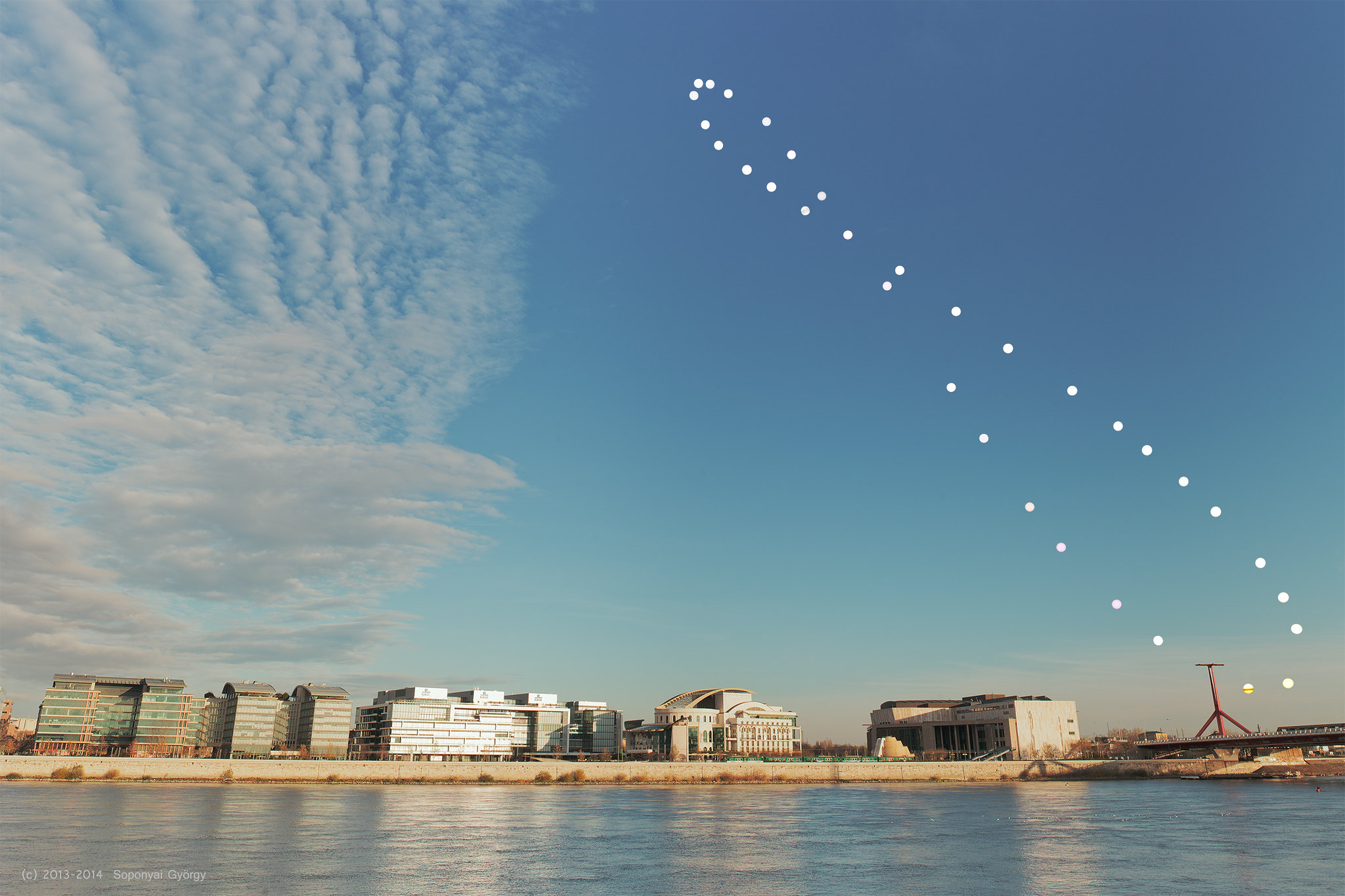
The Sun does trace the analemma shape on the Spacetime Watch over the course of a year. And if you choose to, you can toggle on an analemma overlay that shows its path, just like the visualization above, but a little subtler.
Planets in retrograde#
The word "planet" comes from the Greek planētēs – wanderer. To ancient observers, the planets were lights that moved against the fixed backdrop of stars, tracing their own paths through the zodiac. But their behavior was strange. Most of the time, they drifted eastward through the constellations. But periodically, each planet would slow down, stop, reverse direction, stop again, and resume its normal eastward motion. This retrograde motion seemed to defy explanation.
For nearly two thousand years, retrograde motion was astronomy's central puzzle. The Greek solution, refined by Ptolemy around 150 CE, was ingenious: planets moved on small circles (epicycles) whose centers moved on larger circles (deferents) around Earth. When a planet was on the inner part of its epicycle, its backward motion on the small circle could exceed its forward motion on the large one, producing apparent retrograde motion. The system worked – it predicted planetary positions with reasonable accuracy. But it required ever more epicycles as observations improved – epicycles upon epicycles, a baroque machinery of nested circles. By the 16th century, the system had grown unwieldy.
Copernicus offered a simpler explanation in 1543: retrograde motion is an illusion of perspective. If the planets orbit the Sun, not the Earth, then retrograde motion happens naturally when Earth overtakes an outer planet (or is overtaken by an inner one). Imagine passing a slower car on a highway – as you pull alongside and ahead, the other car appears to move backward against the distant scenery. The same geometry applies to planets.
The visualization below keeps Earth fixed at center – essentially Tycho Brahe's hybrid system, where the Sun orbits Earth but planets orbit the Sun. This geocentric perspective matches how we actually experience the sky. The outer circle represents the firmament, the sphere of fixed stars, with twelve reference points. The reddish dot on the firmament shows where Mars appears against the stars from our vantage point. Retrograde occurs around opposition – when Sun and Mars are on opposite sides of Earth, and Mars is brightest in our sky. Watch the dot slow down, briefly reverse, then resume its path.
Mars retrogrades every 26 months or so, when Earth catches up and passes it. The retrograde loop lasts about 2 months and covers about 15° of sky. Jupiter's retrograde happens yearly (Earth laps it once per orbit), lasting about 4 months. Saturn's is similar but slightly longer. Each outer planet's retrograde is brightest at its midpoint, when it's closest to Earth.
Mercury and Venus behave differently from the outer planets. They never stray far from the Sun – Venus no more than 47°, Mercury no more than 28°. This tether to the Sun was another ancient mystery. The answer, obvious in a heliocentric model, is that Mercury and Venus orbit inside Earth's orbit. They are literally between us and the Sun, forever bound to its vicinity as seen from Earth. They can only appear in the evening sky (following the Sun down) or the morning sky (preceding the Sun up), never in the midnight sky opposite the Sun.
The key moment for observing inner planets is greatest elongation – when the planet reaches its maximum angular distance from the Sun. At greatest eastern elongation, Venus or Mercury sets hours after the Sun, visible in a dark evening sky. At greatest western elongation, they rise hours before the Sun, prominent in the predawn. Venus is by far the more spectacular. At greatest elongation, it can shine at magnitude -4.6, bright enough to cast shadows. Mercury, smaller and always closer to the Sun, is notoriously difficult to spot – visible only briefly in twilight, never against a truly dark sky.
Outer planets – Mars through Neptune – can appear anywhere along the ecliptic, including at opposition (the bottom of the watch face). Unlike the inner planets, they can rise at sunset and remain visible all night. They're also closest to Earth at opposition, making this the optimal time for telescopic observation.
Mars's elliptical orbit brings it much closer to Earth at some oppositions than others. A "perihelic opposition" – when Mars is at opposition while also at its closest point to the Sun – brings Mars within 56 million kilometers. An aphelic opposition keeps it 101 million kilometers away.
The point at which a planet appears in the same direction as the Sun is called a conjunction. For inner planets, inferior conjunction occasionally produces a transit – a rare event when Mercury or Venus crosses the Sun's face as a tiny black dot. Venus transits are extraordinarily rare, occurring in pairs eight years apart, then not again for over a century. The last pair was in 2004 and 2012; the next won't occur until 2117 and 2125. Mercury transits are more common – about 13 per century – but the planet is so small that they're still challenging to observe.
The Moon#
The Moon shines by reflected sunlight, and exactly half of it is always illuminated – the half facing the Sun. What we call "phases" are simply our changing view of this lit hemisphere as the Moon orbits Earth.
At new moon, the Moon is between Earth and Sun. The lit side faces away from us, and the Moon is invisible (except during a solar eclipse, when it passes directly in front of the Sun). At full moon, the Earth is between the Sun and the Moon. We see the entire lit hemisphere, and the Moon rises at sunset, opposite the Sun.
The intermediate phases – crescent, quarter, gibbous – represent intermediate viewing angles. First quarter (half the visible disc illuminated) occurs when the Moon is 90° east of the Sun; last quarter when it's 90° west. The cycle from new moon to new moon takes 29.5 days – the synodic month.
The Moon is the fastest-moving object in the naked-eye sky, drifting its own diameter (about 0.5°) in roughly an hour. This motion means the Moon rises about 50 minutes later each day. We always see the same face, as a result of tidal braking, described in the Earth's formation section further up. The far side was never seen by human eyes until the Soviet spacecraft Luna 3 photographed it in 1959.
If the Moon orbited Earth in exactly the same plane as Earth orbits the Sun, we would have a solar eclipse every new moon and a lunar eclipse every full moon. But the Moon's orbit is tilted 5.1° to the ecliptic. Most of the time, the new moon passes above or below the Sun, and the full moon passes above or below Earth's shadow. Eclipses occur only when the Moon crosses the ecliptic plane at the right moment.
The visualization shows the shadow cones of both Earth and Moon. Each cone has a dark inner umbra (total shadow) and a lighter outer penumbra (partial shadow). When the Moon passes through Earth's umbra, we see a total lunar eclipse. When the Moon's smaller shadow falls on Earth, observers in that narrow path see a solar eclipse.
The two points where the Moon's orbit intersects the ecliptic are called nodes. The ascending node is where the Moon crosses from south to north; the descending node, north to south. Eclipses can only happen when the Sun is near one of these nodes at new or full moon. Complicating matters, the nodes themselves move. Gravitational influence from the Sun causes the Moon's orbital plane to precess, and the nodes drift westward along the ecliptic, completing one circuit in 18.6 years. This cycle is what causes nutation – a tiny wobble in Earth's axis superimposed on the much slower 26,000-year precession. It also means that the twice-yearly periods when eclipses are possible shift earlier by about 20 days each year.
The visualization shows this geometry from above the orbital plane. The ecliptic (the Sun's apparent path) appears as a yellow ellipse; the Moon's inclined orbit in gray. The two nodes, where the orbits cross, are marked in red. See how the nodes slowly drift westward (clockwise) as the Sun completes its annual apparent journey and the Moon races through its monthly orbit. When the Sun approaches a node while the Moon is nearby (new moon) or opposite (full moon), an eclipse becomes possible.
Ancient Babylonian astronomers discovered something remarkable: eclipses repeat in a cycle of 18 years, 11 days, and 8 hours. This period, now called the Saros, is close to but distinct from the 18.6-year nodal precession. The Saros is the near-coincidence of three different "months" – three ways of measuring the Moon's orbital period depending on your reference point.
The familiar synodic month (~29.53 days) runs from new moon to new moon. It's the longest because Earth is also moving around the Sun, so the Moon needs extra time to catch up to the same Sun-Earth-Moon alignment. The draconic month (~27.21 days) measures the time to return to the same node. "Draconic" comes from Latin draco – ancient cultures imagined a dragon devouring the Sun or Moon during eclipses, which happen at the nodes. It's shorter than the Moon's true orbital period because the nodes drift westward; the Moon reaches the node before completing a full orbit relative to the stars. The anomalistic month (~27.55 days) measures the return to perigee, the Moon's closest approach to Earth. "Anomaly" is an old orbital mechanics term for position measured from the point of closest approach.
For an eclipse to repeat with similar geometry and magnitude, all three cycles must align: the Moon must be at the same phase (synodic), near the same node (draconic), and at similar distance (anomalistic). The Saros – 223 synodic months, 242 draconic months, 239 anomalistic months – is where they nearly coincide. A solar eclipse will be followed by a very similar one 18 years later, shifted about 120° westward on Earth (due to the 8-hour fraction). Track a Saros series for centuries, and you can predict eclipses far into the future.
The Antikythera mechanism, that extraordinary Greek clockwork computer from around 100 BCE, included a Saros dial for predicting eclipses. The ancient world understood these cycles well enough to mechanize them – a testament to centuries of patient observation. See the history page for a little bit more on the Antikythera mechanism.
The Spacetime Watch does have an option to show the lunar nodes, so we can see roughly when we're in eclipse season, but beyond this, it does not attempt to predict eclipses. See the next section for how the lunar node markers look.
Meteor showers#
Meteor showers occur when Earth passes through debris streams left by comets (and occasionally asteroids) as they orbit the Sun. These particles, often no larger than grains of sand, collide with our atmosphere at tens of kilometers per second and burn up, creating the streaks of light we call "shooting stars."
The shower's name typically comes from the constellation where its radiant appears – the point in the sky from which all the meteors seem to originate. This is a perspective effect, like driving through snow: the flakes seem to stream from a point ahead of you even though they're falling everywhere. The radiant tells us the direction from which the debris stream approaches.
Three showers stand out as the year's most reliable spectacles:
- Quadrantids (January 3–4) – Named for the now-defunct constellation Quadrans Muralis, with rates up to 120 meteors per hour. The peak is unusually brief, lasting only about 6 hours.
- Perseids (August 11–13) – Perhaps the most famous shower, producing 100+ meteors per hour from debris of Comet Swift-Tuttle. Summer timing and warm nights make this a favorite for casual observers.
- Geminids (December 13–14) – The year's richest shower, with up to 150 meteors per hour. Unusually, its parent body is asteroid 3200 Phaethon rather than a comet – possibly a "dead comet" that has exhausted its volatile ices.
Five additional showers offer good viewing with rates of 20–50 meteors per hour:
- Lyrids (April 21–22) – One of the oldest known showers, with Chinese records dating to 687 BCE. Parent: Comet Thatcher.
- Eta Aquariids (May 5–6) – Debris from Halley's Comet, best viewed from the southern hemisphere.
- Orionids (October 20–21) – Also from Halley's Comet, as Earth crosses the comet's orbit twice a year.
- Taurids (early November) – A broad, slow shower lasting weeks, with occasional bright fireballs.
- Leonids (November 17–18) – Usually modest, but famous for occasional "meteor storms" when Earth encounters a dense debris ribbon, as in 1833 when observers reported thousands of meteors per hour.
Because meteor showers happen when Earth reaches specific points in its orbit, they occur at the same time each year. The watch face can display markers for these showers on the ecliptic ring. When a marker coincides with the Sun's position at the top, that shower is at its peak.
The visualization above shows the ecliptic ring with optional markers that you can toggle on and off. Meteor shower markers appear as "crowns" (larger for major showers, smaller for minor ones). Lunar nodes mark where eclipses can occur. Seasonal markers show solstices, equinoxes and cross-quarter days. All markers have a little diamond-shaped dot at the ecliptic, which is rendered in front of the Sun, Moon and planets, to help us see where they are even when covered. This is particularly important for the Sun, the center of which marks the present moment. So when the "sunspot" of e.g. a meteor shower reaches the middle of the Sun, that would be the prime time to go out and look.
The best time to observe most showers is before dawn, when you're standing on Earth's "windshield" – the side facing into our 30 km/s orbital motion. Meteors hit head-on and burn brighter; after sunset, only those fast enough to catch up with Earth can reach you. The radiant's position also matters: the Eta Aquariids favor southern hemisphere observers because their radiant rises higher in southern pre-dawn skies, while the Perseids favor the north.
The zodiac#
Ancient astronomers divided the ecliptic into twelve equal 30° segments, each named for a prominent constellation along its path. These are still used in astrology, and can be toggled on in the Spacetime Watch. (Note: the watch face version uses simplified trigonometric approximations that introduce ~1-2° of error in planetary positions – fine for casual sky-gazing, but not precise enough for dedicated astrological work where exact sign boundaries matter.)
Two different zodiac systems exist today, and they've drifted apart over millennia:
- The sidereal zodiac, used in Hindu (Jyotisha) and some Western astrology, ties the signs to the actual constellations. "The Sun is in Aries" means the Sun is physically positioned in front of the stars of Aries.
- The tropical zodiac, used in mainstream Western astrology (and what can be shown on the Spacetime Watch), ties the signs to the seasons instead. It begins at the vernal equinox (March 20), which it defines as 0° Aries regardless of which constellation actually lies behind the Sun at that moment. "The Sun is in Aries" means the Sun is in the first 30° of ecliptic longitude after the spring equinox – a seasonal definition, not a stellar one.
When Greek astronomers codified the tropical zodiac around 150 BCE, the two systems were nearly aligned. The vernal equinox occurred with the Sun in front of the constellation Aries, so the seasonal sign matched its namesake constellation. But as we saw in the axial precession section, Earth's axis wobbles over a 26,000-year cycle, slowly shifting which stars appear behind the Sun at any given season. Over the past two millennia, precession has shifted the equinoxes by nearly one full zodiac sign – about 24°. Today, when the tropical zodiac says the Sun is in "Aries" (late March through late April), the Sun is actually positioned in front of the stars of Pisces. The tropical zodiac is now a 2000-year-old snapshot of the sky, frozen in place while the actual constellations have drifted past.
The tropical zodiac signs are used to label the segments, separated by a notch on the outside of the ecliptic. The boundaries begin at 0° (Aries, starting at the vernal equinox point), with each sign spanning exactly 30°. The constellations themselves, of course, vary wildly in size – Virgo sprawls across 44° while Cancer occupies only 20° – but the zodiac signs are idealized geometric divisions.
Above, the seasonal markers are also toggled on, so you can see that solstices and equinoxes coincide with zodiac segment boundaries.
An invitation#
The Spacetime Watch invites you to reconnect with the sky. Glance at the time and notice that Jupiter is approaching opposition, or that Venus is climbing toward greatest elongation. Go outside to look for Saturn based on its angular distance from celestial objects you can identify. See if you can catch Mercury in its brief appearances at dusk and dawn.
And from there, you might want to learn more about how it all works. We've gone into some depth on this page, but you may have been left with many further questions – perhaps about the size of the universe, or how we can measure cosmic distances in the first place, or where it all will end. Before long you'll be reading about the fine-tuned universe and the anthropic principle, interpretations of quantum mechanics, and so on.
Let the Spacetime Watch lead you out beyond the veil of familiar appearances to get your mind boggled by the rich complexity of reality.
References#
- van der Marel, R. P., Fardal, M., Besla, G., et al. (2012). The M31 Velocity Vector. II. Radial Orbit toward the Milky Way and Implied Local Group Mass. The Astrophysical Journal, 753(1), 8.
- Sawala, T., Cautun, M., Frenk, C. S., et al. (2025). No certainty of a Milky Way–Andromeda collision. Nature Astronomy, 9(8), 1206-1217.
- Heller, R., Duda, J.-P., Winkler, M., et al. (2021). Habitability of the early Earth: liquid water under a faint young Sun facilitated by strong tidal heating due to a closer Moon. PalZ, 95, 563-575.
- Korenaga, J. (2023). Rapid solidification of Earth's magma ocean limits early lunar recession. Icarus, 400, 115564.
- Schröder, K.-P. & Smith, R. C. (2008). Distant future of the Sun and Earth revisited. Monthly Notices of the Royal Astronomical Society, 386(1), 155-163.
- Caldeira, K. & Kasting, J. F. (1992). The life span of the biosphere revisited. Nature, 360, 721-723.
- Wolf, E. T. & Toon, O. B. (2014). Delayed onset of runaway and moist greenhouse climates for Earth. Geophysical Research Letters, 41(1), 167-172.